Recent scientific research has confirmed what the Holy Quran affirmed 14 centuries ago
* The topic of offspring is addressed in both the Quran and the Sunnah. The West draws upon Islamic principles in its research
* Islam instituted marriage laws to prevent mixing and preserve lineage through legal marriage
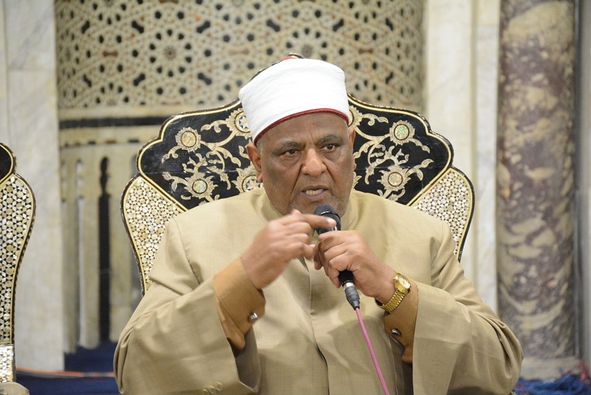
His Eminence Prof. Abbas Shouman, President of the World Organization for al-Azhar Graduates and Secretary-General of the Council of Senior Scholars, praised the well-organized and diverse meetings held at the mosque. He highlighted this new approach that integrates legal and practical aspects, starting with medicine—a critical area. This approach aims to cover all facets of the issues at hand, allowing the truth to be clarified and fostering a sense of complete conviction among participants. The medical perspective on preserving offspring reaffirms, even to skeptics, the greatness of this religion.
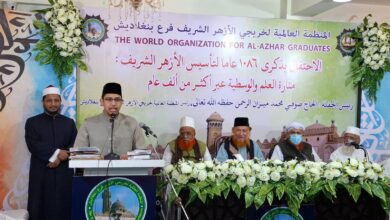
During his speech at the Fiqh Forum held at al-Azhar Mosque, titled “Preserving Offspring between Sharia and Medicine,” Prof. Shouman emphasized the importance of the medical perspective in the issue of preserving offspring. He highlighted the greatness of Islamic teachings, noting that doctors have found no evidence contradicting the scientific facts mentioned in the Quran and Sunnah, from the stages of human creation to death.
Furthermore, the President of the World Organization for al-Azhar Graduates highlighted that scientific research has confirmed that the Holy Quran preceded scholars in correcting misconceptions, such as the belief that flesh forms before bones. The Quran clarifies that bones are formed first and then covered with flesh, aligning with the Prophet’s (PBUH) teachings on the stages of fetal development.
His Eminence pointed out that the parentage issue originally existed in the Quran and Sunnah and that Westerners are benefiting from the Islamic facts while doing their research, where they figure out after many centuries that the results they concluded are actually mentioned in the Quran. Additionally, Prof. Shouman stressed that parentage in Islam is preserved and recognized, where the marriage system in Islam prevents intermingling; hence, lineage in Islam is clearly known where reproduction happens via legal marriage that ensures that the child’s parentage is proven.
In the same context, Prof. Shouman explained that the Islamic Shariah stipulated a clear rule concerning the parentage issue, applicable even in the case of adultery, which is that a child’s parentage is ascribed to the lawful marital bed. Anything other than this Islamic teaching has nothing to do with parentage. Indeed, Islam ensures that a child’s parentage is directly linked to the actual bed, which reflects the importance of marriage along with its pillars and terms that make a woman marry only one man at one time.
Prof. Shouman highlighted that even if a man is married to more than one woman, his children’s parentage is preserved; hence, there is no mixing of lineage, even in the presence of multiple mothers, because the children have only one father. However, if a woman has multiple husbands at the same time, mixing of lineage shall occur and will definitely lead to a crisis in determining the children’s parentage.
Furthermore, Prof. Shouman addressed the false concept of equality, pointing out that those calling for permitting the marriage of a woman to several husbands at the same time do not understand the nature of creation. Indeed, a woman’s womb embraces pregnancy and in the case of polygamy, it will be difficult to determine the child’s father. His Eminence underlined that prohibiting women from marrying more than one man at a time is not a sort of discrimination, yet, it is a kind of protection for them and their children.
In the same vein, Prof. Shouman marveled at the demands of Western women who call for equality with men concerning some of the legal rulings, pointing out that such calls contradict the rulings of Islamic Shariah, as Islam honored women and preserved their dignity in all life aspects.