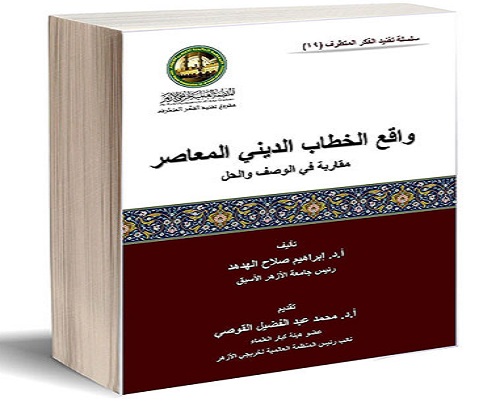
By: Prof. Ibrahim Salah al-Hodhod
Foreword
Praise be to Allah who revealed the Holy Quran as guidance for all people and sent the seal of Messengers (PBUH) as a bearer of glad tidings and a warner.
This book seeks to begin a descriptive study of contemporary religious discourse to come up with solutions. To that end, the book identifies the different types of speech renewal. As a starting point, it specifies the erroneous notions to be corrected based on well-defined criteria. And if human beings cannot live together without specifying landmarks and limits to coexistence, their intellectual and religious life should also be subject to well-defined criteria. Thus, the Prophet (PBUH) is our guide in on this path, as he said in the Hadith narrated by Muslim, Abu Hurairah (May Allah be pleased with him) reported: Messenger of Allah (PBUH) said, “Do you know who is the bankrupt?” They said: “The bankrupt among us is one who has neither money with him nor any property”. He said, “The real bankrupt of my Ummah would be he who would come on the Day of Resurrection with Salat, Saum, and Sadaqah (charity), (but he will find himself bankrupt on that day as he will have exhausted the good deeds) because he reviled others, brought calumny against others, unlawfully devoured the wealth of others, shed the blood of others and beat others; so his good deeds would be credited to the account of those (who suffered at his hand). If his good deeds fall short to clear the account, their sins would be entered in his account and he would be thrown in the Fire”.
This paper has two axes: the first axis deals with contemporary religious discourse. This axis includes three points, namely: The first one isinward-looking discourse and reading in some of its effects. The second one isthe discourse of perversity and deviation. And the third is the discourse of moderation; the discourse that brings together Aql “reason” and Naql “Transmitted text”. As for the second axis, it is devoted to the solution which includes the concept of the religious discourse, the necessity of renewal, the proposed purposes of contemporary discourse, and means of renewal.
The Reality of the Contemporary Religious Discourse
- Inward-looking discourse and a reading of its effects
We are faced with multiple religious discourses, or even opposed discourses. This is not new to the history of Ummah since the multiple religious discourses have been found since the first era. We cite in particular the inward-looking discourse that is understood by the apparent meaning of the text, without grasping its objectives or contexts. This inward-looking discourse resulted in accusing the dissents of infidelity; this subsequently resulted in shedding blood and infringing honor. Throughout history, this discourse is sometimes active, sometimes apathetic. The example of this discourse in our era is the discourse of ISIS which brag about captivity; one of the women of ISIS said: “Praise be to Allah who blessed us with captivity”. We even watch on the websites someone gathers and ties the Muslim women like animals under the name of captivity, holds a loudspeaker and calls for selling them. This is the most shameful image we could see. Such an action reminds us of the Khawarij. When they dared to declare Ali Ibn Abi Talib (May Allah be pleased with him) as infidel in the year of 36 H, although he was the Prophet’s cousin and son-in-law because he agreed to arbitration with his rival; Ibn Abbas went to them while putting on the best garment, they were about 6000. Then, he said to them, “I have come to you from the Commander of the Faithful from the son of the uncle of the Prophet (PBUH) who is his son-in-law. A group amongst them said, “Do not debate with him because verily Allah said: “nay, but they are a people contentious.” [Q. 43:58]. Ibn Abbas said, “What is the grudge you have against the companions of Allah’s messenger and the son of his uncle (‘Alī)?” they replied, “Three points”. They said, “One of the points is that He had men judge in a matter of Allah “As for the second point: then he fought and he did not take captives nor did he take the war booty. If they were disbelievers, then their captives are permissible for us and if they were believers then their captives are neither permissible to take nor was it allowed to fight them (in the first place). The third one: He removed the title of ‘Leader of the Believers’ (Amīr al-Mu’minīn) and if he is not the ‘Leader of the Believers ’then he is the ‘Leader of the Disbelievers’ (Amīr al-Kāfirīn). Ibn Abbas said: “Do you have any points other than these?” They said, “These are sufficient for us.” When Ibn Abbas refuted their three points, one-third of them came back, the second third left and the rest rebelled and fought.
Examples of their crimes due to the inward-looking understanding of the texts: Demolition of monuments:
The most heinous crime they committed was the demolition of the historical monuments in Iraq while they were bragging about that. They posted their videos on websites believing that they are destroying idols. In doing so, they neglected the teachings of the Holy Quran and the Sunnah, and the righteous ancestors as well. It is worth mentioning that the position of Islam towards monuments is very clear.
It can be summarized as follows:
- Remaining of the monuments in the countries that were conquered by the early Muslims in Egypt and other countries. These conquests were led by the Companions (May Allah be pleased with them). Needless to say that they are the best generation humanity has ever known.
- The Holy Quran ordered us to travel on earth to reflect on the traces of the ancestors. Allah said in the Holy Quran: “Have they not traveled in the land and beheld how was the consequence for those before them? They were more powerful than them, and they affected the land and developed it more than these have developed it; and their messengers brought them, clear signs for God would never wrong them, but they used to wrong themselves.” [Q. 30:9] Allah said also: “Have you not seen how your Lord dealt with ‘ād, Iram of the towering ones —the like of which was not created in the land.” [Q. 89:6-8 ]
- Those who support the demolition of monuments should destroy the sun, the moon, cows, and trees as well as all other things that worshiped instead of Allah.
- There is a difference between idols and monuments. And there is a divine separation between the prohibition of the idolatry of different kinds and the attitude towards the worshiped things and shattering the idols by Abraham (PBUH); it was intended to lead a debate with his people. At some point, some people worshiped planets, the sun, and the moon, which are creatures that Allah has made subject to serve the universe and the people. Does it make sense to take a negative attitude to the sun, the moon or others? And these things are worshiped by some people, believing that they bring them closer to Allah. Allah said: “And of His portents are the night and the day and the sun and the moon. Adore not the sun not the moon; but adore Allah Who created them, if it is in truth Him Whom ye worship.” [Q. 41:37]
In the story of Abraham (PBUH) we learn an important lesson; he didn’t target the idols itself, but rather to prohibit worshiping it and to conduct a debate with his people. If he fought them for their own sake, he would not keep their elder. He did that out of irony of his people. Allah said: “And verily We had given Abraham his rectitude before, and We were Aware of him (51) when he said to his father and his people, ‘What are these images to which you [constantly] cleave? (52) They said, ‘We found our fathers worshipping them. (53) He said, ‘Truly you and your fathers have been in manifest error’.(54) They said, ‘Do you bring us the truth, or are you being frivolous?’(55) He said, ‘Nay, but your Lord is the Lord of the heavens and the earth, [the One] Who originated them, and to that I am a witness. (56) And, by God, I shall devise [a stratagem] against your idols after you have gone away, with your backs turned’.(57) And so he reduced them to fragments, [all] except the principal one among them, that they might return to it. (58) They said, ‘Who has done this to our gods? Truly he is an evildoer’. (59) They said, ‘We heard a young man making [ill] mention of them – he is called Abraham’. (60) They said, ‘Then bring him before the people’s eyes that they may testify’. (61) They said, ‘So, is it you who has done this to our gods, O Abraham?’(62) He said, ‘Rather it was this principal one among them did it. So question them, if they can speak!’ (63) So they turned [thinking] to themselves, and they said, ‘Truly it is you who are the evildoers’.(64) Then they were turned on their heads, [and said], ‘You are certainly aware that these [idols] cannot speak’. (65) He said, ‘Do you then worship, besides God, that which cannot benefit you in any way, nor harm you? (66) Fie on you and what you worship besides God. Do you not comprehend?’(67) They said, ‘Burn him and stand by your gods, if you are to do anything’. (68) We said, ‘O fire! Be coolness and safety for Abraham!’ (69) And they sought to outwit him, but We made them the greater losers.(70) [Q. 51:70 ]
One of their crimes that they differentiate between (Abode of disbelief) Dar al-Kufr and the (Abode of Islam) Dar al-Islam, as well as immigration from homelands based on this understanding.
It has been narrated on the authority of Ibn Abbas that the Messenger of Allah (PBUH) said on the day of Conquest of Mecca: “There is no Hijrah now, but (only) Jihad and sincerity of purpose; when you are asked to set out (on an expedition undertaken for the cause of Islam) you should (readily) do so.” Immigration in the origin of language means leaving. Then, it means to move from land to another land. It has been widely used for the immigration of Abyssinia and Madinah. As for immigration in Shariah, it means to leave what is forbidden by Allah. Moreover, leaving the homeland was replaced by Jihad and good intentions. Needless to say that immigration was an obligation on who converted to Islam in Mecca before the Conquest of Mecca to feel secure about his religion and from the harm of disbelievers. Thus, Allah valued the immigration when He said in the Holy Quran: “As for theَ unbelievers, they are friends one of another. ۚ Unless you do this, there will be persecution in the land and great corruption.”[Q. 8:73] This matter remained like that until the Conquest of Mecca, and then the obligation of immigration was abrogated. Rather, the scholars indicated that there is nothing wrong with staying in Dar al-Kufr since the Conquest of Mecca until the Day of Resurrection, as long as the Muslim is capable to practice the rituals of his religion. Al-Mawardi (May Allah be merciful to him) pointed out to the merit of staying a Muslim in Dar al-Kufr, as he said that Muslim’s residence in Dar al-Kufr is better than leaving it; it is hoped that his residence will be a reason for others to convert to Islam. It is a statement of truth supported by the evidence of Shariah. In summary, the Muslim should not immigrate lest he should be put to trial because of his religion. As Aisha said when Ubaid bin Omar asked her about migration: “There is no migration today. A believer used to flee with his religion to Allah and His Prophet for fear that he might be put to trial as regards his religion. Today Allah has rendered Islam victorious; therefore a believing one can worship one’s Lord wherever one wishes. But there is Jihad for Allah’s Cause and intentions.” And the Prophet defined the true emigrant in the Hadith that narrated by al-Bukhari: “A Muslim is the one from whose tongue and hands the Muslims are safe, and a Muhajir (Emigrant) is the one who refrains from what Allah has forbidden”. Furthermore, Qadi Ayyad said that the Ummah agreed that it is forbidden for the emigrant to return to his homeland; it was imposed on him only in the time of the Prophet (PBUH) to support him or to be with him, or because it was before the Conquest of Meccah. When the Conquest took place and Allah manifested Islam over every religion, humiliated infidelity and honored Muslims, the obligation of immigration fell, as the Prophet said: “There is no emigration after the Conquest of Makkah”. He said also: “The period of migration has expired”, that is to say, those who left their homes and property before the Conquest of Meccah to consolidate the Prophet (PBUH), support Islam and apply Islamic law.
The deviation from the right intended meaning of the text:
Some pseudo-theologians have badly explained the Hadith by diverting it from its true meaning. They did not realize the indisputable linguistic meaning of the Hadith Moreover, they affirmed the necessity of emigration from Dar al-Kufr. To support their point of view, they relied on verses that encourage emigration before it was abrogated, neglecting its context. Then they relied on some weak narratives, such as: “Any Muslim who stays among the polytheists, does not belong to me.” And also this Hadith: “Migration will not end until repentance ends, and repentance will not end until the sun rises in the west.” The first Hadith was narrated by the three Imams. This Hadith is intended to the status before the Conquest of Meccah or those who might be put to trial. The second one was narrated in Musnad Ahmad ibn Hanbal, Sunan Abu Dawood, and Sunan an-Nasa’i; it is a weak Hadith because Abu Hind al-Bagly was included in its transmission and he was unknown to scholars of Hadith.
Ignorance of the situational context and the linguistic context is one of the greatest pitfalls in the fiqh of the text:
Understanding the Quranic verses and the prophetic Hadith without taking into consideration the context, the situation, or the objectives of Islamic law is a very dangerous trap against which the ancestors have warned us. For example, al-Shatibi’ said in his book al-Muwafaqat: “Any recipient of a text must pay attention to all the content of the text, the main question, and the purpose. It doesn’t make sense to understand the following Hadith apparently. Al-Mughirah ibn Shubah narrated: “One night I became the guest of the Prophet (PBUH). He ordered that a piece of mutton be roasted, and it was roasted. He then took a knife and began to cut the meat with it for me. In the meantime, Bilal came and called him for prayer. He threw the knife and said: What happened! May his hands be smeared with earth! He then stood for offering prayer. Al-Anbari added: My mustaches became lengthy. He trimmed them by placing a tooth-stick; or He said, I shall trim your mustaches by placing the tooth-stick there. It doesn’t make sense that it means that the Prophet (PBUH) cursed Belal, but the context implied that he supplicated for him. As the saying of “May his hands be smeared with earth” means “May he is blessed”. “
Those who understand the Hadith far from context, they have divided the world, in our time, to Dar al-Kufr and the abode of Islam. They thought that they must immigrate from Dar al-Kufr to the abode of Islam. Thus, they left their homelands. In reality, all Muslims all over the world currently practice the rituals of their religion freely. No one prevents them. Moreover, the mosques are everywhere in Europe, Russia, and the entire world. The Prophet (PBUH) himself changed the concept of Hijrah when the reality changed after the Conquest of Meccah; the concept of migration that will continue until the Day of Resurrection is “The emigrant is the one who abstains from that which Allah has prohibited.”
There is a big difference between the conditions of the early Muslims and the stabilized societies now. Thus, we should not refer to the following verses in this regard: “And those who believe, but have not emigrated — you have no duty of friendship towards them till they emigrate.” [Q. 8:72] And this one: “And those who have believed afterward and emigrated, and struggled with you — they belong to you;” [Q. 8:75] And this one: “And those the angels take, while still, they are wronging themselves — the angels will say, ’In what circumstances were you?’ They will say, ’We were abased in the earth.’ The angels will say, ’But was not God’s earth wide so that you might have emigrated in it?’ Such men, their refuge shall be Gehenna — an evil homecoming!” [Q. 4:97].
Immigration which means leaving homeland and residing in another land, for the early Muslims, is an exodus, to which they were forced by their people, as Allah said in the Holy Quran: “And those who emigrated, and were expelled from their habitations” [Q. 3:195] The first destination of the early Muslim emigrants was Abyssinia due to the abuse of the disbelievers. Later, the Messenger of Allah (PBUH), emigrated to Medina, and all Muslims joined him because of the harm of the disbelievers. In this context, emigration means that Muslims have been forced to leave their homeland. It is in this sense also that we must understand the following words of Warqa ibn Nawfal: I wish I were young and could live up to the time when your people would turn you out.” Allah’s Apostle asked, “Will they drive me out?” Waraqa replied, anyone who came with something similar to what you have brought was treated with hostility;
The scholar al-Tiby explained the following verse: “But was not God’s earth wide so that you might have emigrated in it?” [Q. 4:97 ], saying: You were able to leave Mecca to go to countries where you are forbidden to practice your religion, to emigrate to Medina where the Messenger of Allah is (PBUH) as did the early Muslims who had already emigrated to Abyssinia. This indicates that if a man has become unable to practice his religion in his own country for any reason (the reasons which prevent them from practicing religion are endless), or if he is convinced that his stay in a country other than his own allows him to always fulfill his obligations to Allah, then it is incumbent on him to emigrate.