Prof. Shouman Urges the Acceptance of Diversity & Difference and to Adopt the Prophetic Approach While Dealing with Non-Muslims
Prof. Abbas Shouman, the Secretary General of al-Azhar Council of Senior Scholars, President of the World Organization for al-Azhar Graduates, highlighted the global endeavors exerted by Prof. Ahmad at-Tayyeb, the Grand Imam of al-Azhar to foster the Inter-Islamic Dialogue. He added that His Eminence’s call, two years ago in Bahrain, to embrace such dialogue was well-received by the different Islamic schools, and it has been decided to launch the first session of this dialogue next month.
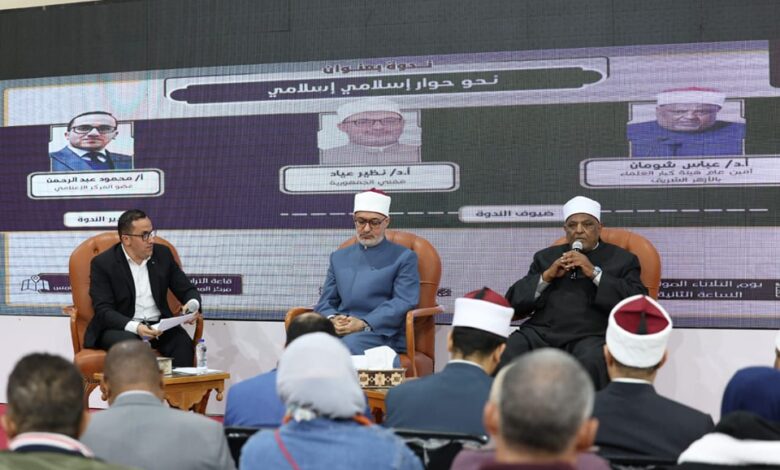
This came during the seminar convened by al-Azhar pavilion in Cairo International Book Fair, under the title of “Towards Inter-Islamic Dialogue”, during which Prof. Shouman urged all Muslims to adopt the Prophetic approach while dealing with non-Muslims. He added that while the Prophet (PBUH) accepted to peacefully coexist with those who differ with him in religion, we, as Muslims, should have better communication among us and to accept diversity and differences. In this regard, religious institutions bear a huge responsibility in their pursuit to establish the values of peaceful coexistence and accepting the other pursuant to the Prophetic Sunnah and the teachings of our esteemed Shari’ah.
In the same context, Prof. Shouman underlined the example of the first Muslim scholars, who are considered as role models in accepting and respecting differences. Those scholars established the various jurisprudential schools that display the spirit of mutual respect, benevolence and gratefulness, without any conflicts or fanaticism amongst them. The four Sunni schools (Hanafi, Maliki, Shafi’i and Hanbali), for instance, were founded by significant imams who had had mutual respect. Indeed, Imam al-Shafi’i had had great regard for Imam Abu Hanifa, despite the fact they never met, as Imam al-Shafi’i was born in 150 H., the same year Imam Abu Hanifa passed away. Ideed, Imam al-Shafi’i gained his knowledge from the followers and students of Imam Abu Hanifa, especially Imam Mohammad ibn al-Ḥassan ash-Shaybānī.
His Eminence added that Imam al-Shafi’i used to say: “all people, in Fiqh, depend on Abu Hanifa”. The respect of Imam al-Shafi’i to Imam Abu Hanifa was so great that when Imam al-Shafi’i visited the city where Imam Abu Hanifa was buried, he performed the Witr Prayers in three connected Rakaʿāt pursuant to Hanafi schools, saying that: “I felt ashamed to disobey the Imam in his presence”. Prof. Shouman added as well that Imam Ahmad ibn Hanbal was one of Imam al-Shafi’i students; however, he intended to establish his own independent jurisprudential school. As a matter of fact, Imam Ibn Hanbal had had a great respect for Imam al-Shafi’i, that he once said: “I have never forgotten, after Imam Shafi’i’s death, to pray for him in any of my prayers”.
Prof. Shouman underlined that such significant relation that gathered these imams reflects their mutual cooperation and respect, a feeling that should prevail among all Muslims nowadays. He stressed that mentioning the narratives of the aforementioned imams does not indicate emphasizing their jurisprudential schools in particular, however, it is for the sake of giving an inspiring example of the possibility of mutual peaceful coexistence and understanding despite the jurisprudential, doctrinal or religious differences. Allah almighty says: “You have your religion and I have my religion.” [Q:109:6] and “There is no compulsion in religion” [Q:2:256]. These verses explain that a human being enjoys the freedom of choice, whoever wishes to believe, so be it and whoever wishes to disbelieve, that will be his/her own choice. Although disbelief is not equal to faith, by any means, whether in value or consequences, yet, the Islamic Shari’ah gives the human beings the freedom to choose their paths, whether to embrace Islam or any other religions.
His Eminence concluded the seminar by pointing out that although these principles are very clear and explicit in the Islamic Shari’ah, however, we actually neither accept the diversity of religions nor righteously practice the peaceful coexistence stipulated by our religion. When Prophet Mohammad (PBUH) entered Madinah, he found many Jewish tribes, yet, he did not order their expulsion; however, he made peace conventions with them to preserve their rights as long as they are committed to no hostility and when they violated their agreements with the Prophet (PBUH), they were punished for the violation not their religious difference. If peaceful coexistence between Muslims and non-Muslims is accepted and applicable in our esteemed Shari’ah, it will be more appropriate to make peaceful coexistence among Muslims a tangible reality. Prof. Shouman concluded his word by urging all Muslims to renounce the conflicts and divisions the Islamic world is witnessing nowadays between Sunni and Shi’i, Salafi and Ash’ari, Maturidi and Muʿtazilī, and even among the followers of the same school.