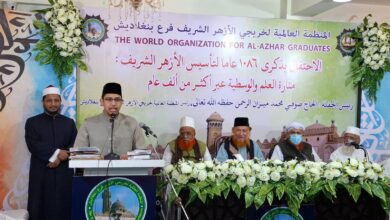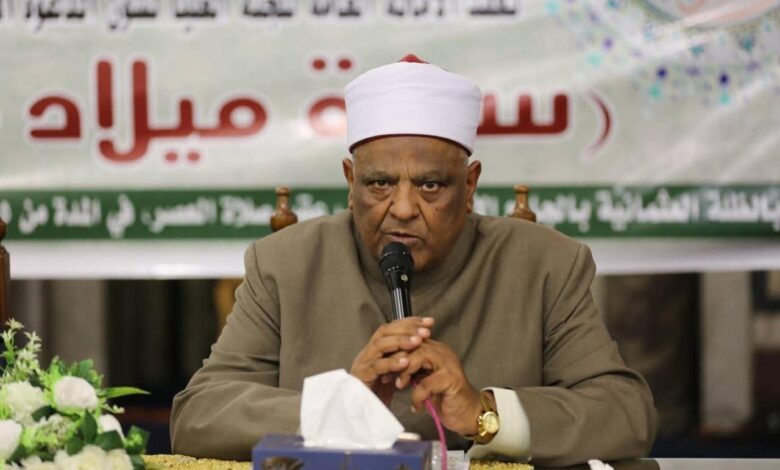
Al-Azhar ash-Sharif concluded the activities of the Eleventh Dawah Week of al-Azhar ash-Sharif, organized by the Higher Committee for Dawah in cooperation with al-Azhar Mosque entitled “Biography of birth and building glory,” with a seminar on “The nation’s duties towards the Messenger of Allah (pbuh).” The event was attended by His Eminence Prof. Abbas Shuman, President of the World Organization for al-Azhar Graduates and Secretary-General of al-Azhar Council of Senior Scholars, and His Eminence Prof. Hassan Yahya, Secretary of the Higher Committee for Dawah at al-Azhar ash-Sharif.
At the beginning of the seminar, Shuman emphasized that the mission of the Prophet (pbuh) is considered one of the most difficult and greatest missions, as it came to a nation living in complete ignorance and darkness. The scales were overturned, the strong devoured the weak, and it was governed by the law of the jungle. Social customs were barbaric – they would bury girls alive without guilt, and the economy was based on usury, causing long wars and widespread corruption in all aspects of life. His call was like a ray of light that came to bring this nation out of the darkness of ignorance into the light of truth, justice, and mercy.
In addition, he explained that the Prophet’s message was not limited to his people alone, but was universal and comprehensive, addressed to all people in every time and place. This matter required tremendous effort, especially in a time when means of communication and transportation were not available, which increased the difficulty of spreading the call. He also noted that the Prophet (pbuh), with Allah’s guidance and the help of the noble Companions, was able to spread Islam widely in a period not exceeding a quarter of a century. This would have been a nearly impossible task without divine assistance and support from the Companions who believed in Him and defended his message. They were the best help to him in achieving this miracle – transforming a nation from darkness to light and spreading the noble values of Islam in a society that was suffering from decline.
He also added that the Prophet (pbuh) was a unique model of humility, as he would sit among his Companions without distinguishing himself from them, making it difficult for those who didn’t know him to differentiate between him and them. This humility was not merely a personal trait, but was a practical lesson in the importance of humility. This Prophetic approach shows that when a community is sincere and loving, it becomes like one person, with the individual dissolving for the sake of the common interest. The Prophet’s methodology in educating his Companions aimed at building this unique cohesion, instilling in them the values and morals that made them conform to his characteristics and actions, making them all represent the true image of Islam.
Moreover, he pointed out that the Islamic nation today, nearly fifteen centuries after the birth of the noble Prophet (pbuh), suffers from deviation and deep dysfunction in its moral system and values due to its distance from the noble Prophetic methodology. What societies suffer from today is the spread of injustice, the waste of rights, and the prevalence of laziness, which has led to the destruction of society’s basic values. He pointed to the danger of voices that deny the fundamentals of religion and mock them, claiming that they thereby achieve ‘enlightenment.’ We see those who deny the prohibition of alcohol, call for immodesty, and even go beyond that to deny miracles like al-Isra and al-Miraj, in an attempt to cast doubt on religious constants. These attempts are nothing but destruction of the nation’s values and spirit. He explained that true commemoration of the Prophet’s birth is through following his example and adhering to his teachings, which are the safety valve for our nation. Following the Prophet (pbuh) is evidence of love for him, and love for the Prophet is a pillar and part of faith, not a favor from the Muslim to the Prophet.
Besides, he pointed out that despite his forbearance and patience, the Prophet (pbuh) would become angry and agitated when Allah’s sanctities were violated, and we must follow his example in this. Whoever sees behavior that violates Allah’s law must denounce this act and apply the saying of the Messenger in defense of religion “Whosoever of you sees an evil, let him change it with his hand; and if he is not able to do so, then [let him change it] with his tongue; and if he is not able to do so, then with his heart — and that is the weakest of faith.” He explained that change by force is available only to authorities responsible for law enforcement, such as relevant government institutions.
He commended the importance of Islamic unity and solidarity in facing challenges, emphasizing that this unity is not merely a slogan, but an authentic Prophetic methodology. He pointed out that celebrating the Prophet’s birth should be an opportunity to renew our commitment to follow his path, not just through traditional celebrations, but by applying his methodology in our lives. This should be done through raising children with good character and proper behavior as the Messenger did in all situations. The Prophetic birth should be a methodology for peaceful coexistence, which requires us to address shortcomings in applying the Prophetic Sunnah in everything in our lives.