• Issuing fatwas is a serious responsibility that may only be carried out with solid knowledge and a precise understanding of reality
•The differences among jurists reflect a diversity rooted in considerable scholarly ijtihad (independent reasoning)
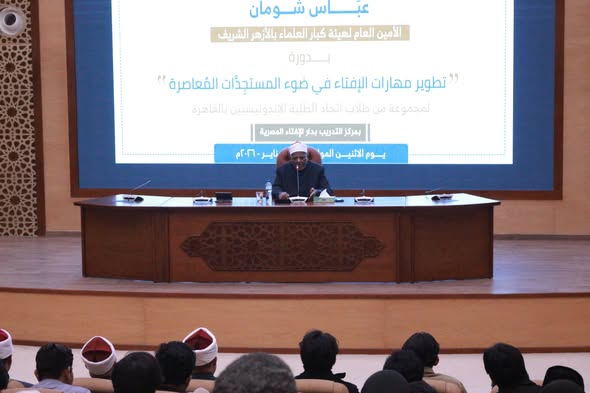
Prof. Abbas Shouman, President of the World Organization for al-Azhar Graduates and Secretary-General of the Council of Senior Scholars at al-Azhar ash-Sharif, delivered an expanded academic lecture at the Training Center of the Egyptian Fatwa House as part of the course “Developing Fatwa Skills in Light of Contemporary Developments,” organized by the Fatwa House for students of the Indonesian Students Union in Cairo.
At the outset of his lecture, His Eminence welcomed the international students, expressing his pleasure at their presence at al-Azhar and the Egyptian Fatwa House. He emphasized that all religious institutions in the Arab Republic of Egypt work to serve the Islamic Ummah without discrimination, striving to transmit both scholarly and practical expertise in the fields of dawah and fatwa, while building rational awareness grounded in moderation. He further stressed that al-Azhar and the Egyptian Fatwa House exert great efforts to qualify muftis, confront extremist ideology, and address emerging intellectual and societal issues. He added that these efforts aim to prepare preachers and muftis capable of understanding reality and addressing the problems of their societies with sound Islamic legitimacy.
He added that many of the issues facing Islamic societies today were unknown in earlier eras, which explains the absence of detailed discussions of them in classical heritage works. He further noted that the scholars of the Ummah did not fail to clarify the methodology; rather, they established general rules and foundational principles that enable scholars in every era to address new developments. He emphasized that the door of ijtihad (independent reasoning) has not been closed; however, attaining the rank of an “absolute mufti” has become extremely rare due to the scarcity of those fully qualified.
He pointed out that work in the religious field—especially in issuing fatwas and engaging in preaching—is not based on force, harshness, or raising one’s voice, but rather on knowledge, the Quran, the Sunnah, and established legal principles, along with wisdom and persuasion. He emphasized that these are the true tools of the preacher and the mufti, noting that good character, gentleness, and patience with people were among the defining qualities evident in the life of the Prophet (PBUH), as well as in the conduct of his noble Companions and the righteous predecessors.
In this context, the Secretary-General of the Council of Senior Scholars cited several Prophetic examples that embody this approach, explaining how the Prophet (PBUH) dealt with those who erred or posed challenging questions, even in situations that might provoke anger. He stressed that Islam does not permit assaulting or offending an offender, regardless of the intensity of disagreement, citing well-established Shariah principles derived from the Quran and the Sunnah that govern proper conduct toward others.
Moreover, His Eminence presented practical examples from the Prophetic biography related to the issuance of fatwas, including the story of the woman who committed two grave sins—adultery and killing—and how an incorrect fatwa can lead people to despair of the mercy of Allah. He explained how the Prophet (PBUH) corrected this mistaken understanding and clarified the vastness of Allah’s mercy, as affirmed by Quranic verses stating that sincere repentance erases sins and may even transform them into good deeds. Notably, His Eminence referred to the story of the man who came to the Prophet (PBUH), confessing that he had committed a forbidden act during Ramadan. He explained how the Prophet (PBUH) addressed the man’s psychological and practical state, combining a clear statement of the gravity of the sin with reassurance for the questioner, while identifying the appropriate legal course of action for his situation. He emphasized that this Prophetic method represents an authentic principle in the process of issuing fatwas.
Furthermore, His Eminence emphasized that a fatwa is not merely the transmission of a jurisprudential ruling, but a complex process requiring a precise understanding of the questioner’s situation, awareness of their reality, and careful distinction between words and intent. He warned against hastily issuing an answer without fully grasping the issue or relying solely on the apparent meaning of the questioner’s words. The mufti must ask multiple—sometimes indirect—questions to uncover the true nature of the matter, reviewing practical examples in areas such as divorce and inheritance. This demonstrates how misunderstanding or insufficient clarification can result in an incorrect fatwa, even when the deduction from the underlying texts is technically sound.
His Eminence addressed the issue of audacity in issuing fatwas, noting that a mufti’s statement of “I do not know” reflects high scholarly integrity. He urged careful development of knowledge in fatwas rather than rushing to provide answers, explaining the distinction between an error arising from disciplined ijtihad, which carries no blame, and an error resulting from ignorance or negligence, which is considered sinful. He stated that a qualified scholar, if he exerts his utmost effort and adheres to Shariah principles, is rewarded in all cases—whether his ruling is correct in Allah’s judgment or not. He emphasized that differences among scholars in jurisprudential matters reflect a diversity grounded in considerable ijtihad.
At the conclusion of the lecture, the Secretary-General of the Council of Senior Scholars advised trainees on the necessity of sound scholarly preparation before engaging in fatwa work. He stressed the importance of recognizing the seriousness of this responsibility and being mindful of Allah Almighty in every word issued by the mufti, noting that an erroneous fatwa affects those who encounter it without knowledge. His Eminence expressed his wishes that the international students would have a fruitful scholarly experience at al-Azhar and the Egyptian Fatwa House and that they would return to their countries equipped with sound knowledge and a moderate approach, thereby contributing to the service of their communities and the promotion of intellectual and religious stability in their homelands.