Prepared and interviewed by: Athar al-Taweel
Supervised by: Saad Al-Mutaani
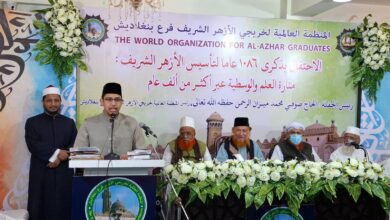
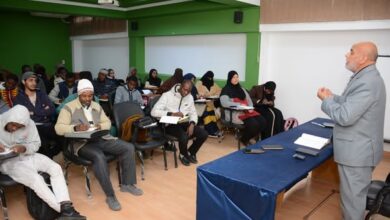
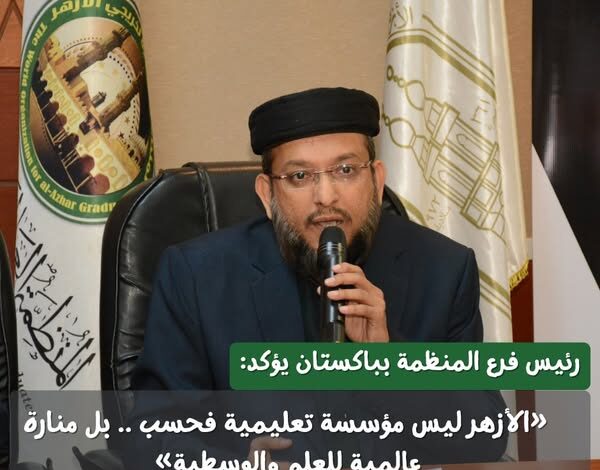
On the sidelines of the training course for Pakistani imams, organized by the World Organization for al-Azhar Graduates in collaboration with Al-Azhar International Academy for Training Imams, Preachers, and Fatwa Researchers—within the framework of supporting and qualifying scholars and preachers and promoting the moderate Azhari approach worldwide—we conducted this interview with the Head of the Organization’s branch in Pakistan. The interview sheds light on al-Azhar’s efforts to support its graduates within Pakistani society, spread the Azhari methodology, address the intellectual challenges it faces, and promote peaceful coexistence.
First of all… To begin with, how would you evaluate your current engagement with al-Azhar?
I thank Allah Almighty for this great honor of being present at al-Azhar ash-Sharif and the World Organization for al-Azhar Graduates. This great scholarly edifice is not limited in its virtue to Egypt alone; rather, its influence extends to the entire Islamic world. Throughout the centuries, al-Azhar has remained a beacon of knowledge and moderation.
In your estimation, why is al-Azhar so deeply loved and appreciated by Pakistani scholars?
Al-Azhar holds a special place in the hearts of Pakistani scholars due to the vast knowledge of its scholars, coupled with their piety and mastery of the various Shariah sciences. Moreover, al-Azhar has played a vital role in spreading Islam in its correct and moderate form—an approach the world needs today in the face of extremism and excess.
If we were to discuss the difference between those who hear about al-Azhar and those who experience it firsthand, how would you describe it?
There is a great difference between hearing about al-Azhar and witnessing it firsthand. Many people know al-Azhar only by reputation, but those who visit it and immerse themselves in its scholarly environment discover a unique depth of both intellectual and spiritual significance. The Pakistani scholars participating in the training course have experienced this depth firsthand; even those who have not fully mastered the Arabic language have benefited from al-Azhar’s knowledge, which reflects one of the great strengths of the Azhari curriculum.
How do you assess the spread of the Azhari approach in Pakistan?
The Azhari approach has been present in Pakistan for many years, but it has experienced remarkable growth in recent times, particularly due to the increasing number of al-Azhar University graduates who hold key academic and governmental positions. These graduates promote the Azhari ideology from the pulpits and within educational institutions. Additionally, the branch of the World Organization for al-Azhar Graduates in Pakistan has played a pivotal role in supporting and expanding this influence.
What are the main intellectual challenges that you encounter in Pakistan?
The most prominent of these challenges is the spread of certain extremist and radical ideas, largely due to the weak consolidation of correct Islamic legal knowledge. This is where al-Azhar graduates play a crucial role: they confront these ideas with reason and scholarship, dismantle extremist discourse, and promote a culture of moderation and balance.
Are there any currents of thought that obstruct this role?
Yes, some currents embrace radical ideas and receive both material and intellectual support to promote violence and extremism. Nevertheless, the Azhari approach remains fully capable of confronting them through enlightened reasoning and sound knowledge.
In your view, how can the role of the Azhari approach be further strengthened in Pakistan?
The role of the Azhari approach can be strengthened by increasing support for the dissemination of al-Azhar’s thought and expanding specialized training courses, given their direct impact on qualifying scholars and preachers. In addition, establishing effective communication and support mechanisms for influential scholars and researchers—who can positively shape their communities—will help consolidate al-Azhar’s moderate approach and reinforce its presence in the face of extremist currents.
In conclusion, is there a message you would like to share?
We extend our sincere thanks to His Eminence the Grand Imam of al-Azhar, Prof. Ahmad at-Tayyeb, to Prof. Abbas Shouman, President of the World Organization for al-Azhar Graduates and Secretary-General of the Council of Senior Scholars, as well as to all officials of the Organization and Al-Azhar International Academy for Training Imams, Preachers, and Fatwa Researchers, for their tireless efforts in serving moderate Islam. We pray to Allah to preserve al-Azhar as a beacon of knowledge and moderation.
Head of the World Organization for Al-Azhar Graduates in Pakistan in lines
Prof. Uzair Mahmoud, born in Karachi, Pakistan, on November 2, 1977, holds a doctorate from the University of Sindh. He currently serves as the Head of the World Organization for al-Azhar Graduates in Pakistan. He is recognized as one of the most prominent scholarly voices advocating the culture of peace and tolerance and promoting the consolidation of the Azhari moderate approach within Pakistani society.