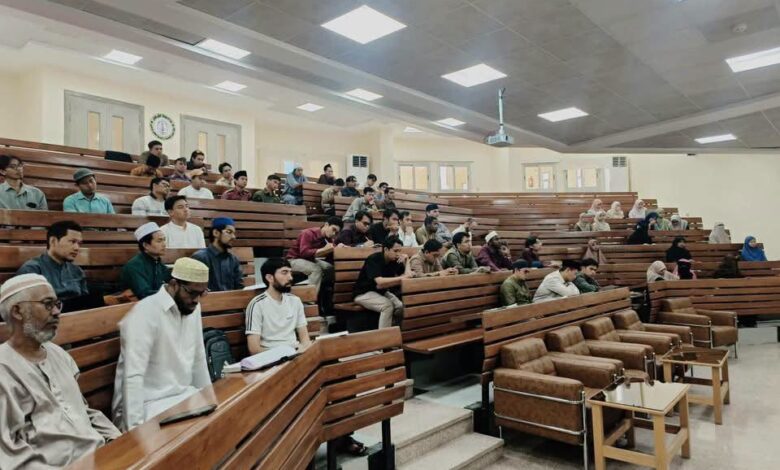
The training program “Correcting Thought and Building Awareness” continues at the Faculty of Islamic and Arabic Sciences for International Students, organized in cooperation with the World Organization for al-Azhar Graduates. The program reflects the Faculty’s commitment to its scholarly and preaching mission, to help in building the awareness of international students, to consolidate the moderate approach and to safeguard students against misconceptions and deviant ideas.
The program is held under the generous patronage of Prof. Nahla Sabri al-Saidi, Dean of the Faculty and Advisor of the Grand Imam for International Students’ Affairs, and under the supervision of Prof. Shahida Marʿi, Vice-Dean of the Faculty for Postgraduate Studies and Research. The Program also features the participation of a distinguished group of al-Azhar University professors specializing in the Islamic and intellectual sciences.
As part of the program, Prof. Ragab Khidr, Professor of ‘Aqida and Philosophy at the Faculty of Usul al-Din, delivered a scholarly lecture on “Responding to the Misconceptions and Claims Raised about Qur’an” and “Women’s Issues and Freedom”. He reviewed a number of issues commonly raised about the Holy Qur’an, setting out the scholarly and methodological foundations for addressing and responding to them.
Prof. Mahmoud Abdul Rahman, Professor of Usul al-Fiqh at the Faculty of Sharia, also delivered a lecture on “How to Confront Extremism, Excessiveness and Takfir”. He explained the scholarly method for understanding religious texts, the principles governing their interpretation and ways of preventing extremist ideas that arise from misunderstanding or from deviation in the reception of texts and in deriving rulings from them.
Both lectures drew notable engagement from the international students, who showed keen interest in the topics presented and were eager to take part in the discussion and to ask questions. This reflects the importance of these topics and their direct relation to the renewed intellectual challenges that youth face.