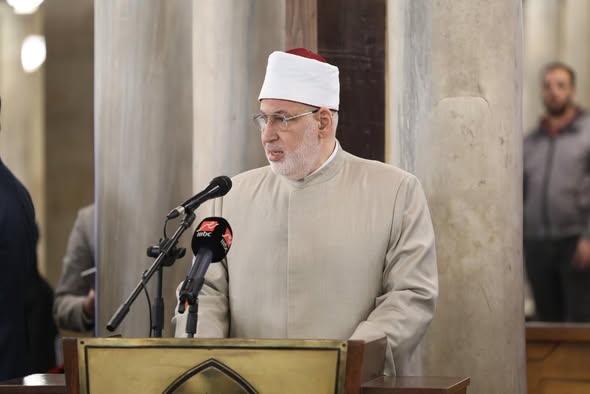
Al-Azhar organized a major ceremony marking the 1086th anniversary of the founding of the mosque, in the presence of His Eminence Prof. Mohammad ad-Duwini, Deputy of al-Azhar; Prof. Nazir Ayyad, Grand Mufti of the Republic; Prof. Salama Dawood, President of al-Azhar University; Prof. Mohammad al-Gendy, Secretary-General of the Islamic Research Academy; Sheikh Ayman Abdul-Ghani, Head of al-Azhar Institutes Sector; and a group of Azhari leaders and scholars.
The speech delivered by al-Azhar’s Deputy included ten key messages that outlined the defining features of al-Azhar’s approach throughout its history and articulated an intellectual framework clarifying the principles governing its engagement with religion, reason, and scriptural texts. The speech also reaffirmed al-Azhar’s enduring constants in understanding and defending the Shariah and the Prophetic Sunnah, namely:
• Today, we celebrate a legacy of scholarly diligence, a long-standing commitment to defending the immutable principles of religion, a profound appreciation of the role of reason in the light of revelation, and a firm bond between the Book of Allah and the Sunnah of His Messenger.
• From its very inception, al-Azhar recognized that Islam came with a message that speaks to the human intellect, unleashes its potential, and calls it to the pursuit of knowledge.
• In the Islamic conception, reason is neither an adversary of the text nor opposed to revelation; rather, it is the instrument of understanding through which the higher objectives are discerned, and certainty is attained.
• In Islam, the relationship between reason and revelation is one of integration, not conflict, and cooperation, not contradiction. If an apparent tension arises between reason and the text, the flaw lies in human understanding or reasoning—not in the essence of the religion itself.
The Azhari methodology is founded upon harmonizing reason and transmission, as well as textual evidence and rational proof, in a precise balance that has safeguarded the Ummah from excess, negligence, and extremism.
• Since its establishment, al-Azhar has stood as a beacon of knowledge and a gathering place for scholars from across the Islamic world. Though states have succeeded one another, it has remained unwavering in its mission.
• Throughout its history, al-Azhar has embraced an approach grounded in harmonizing reason and transmission. This synthesis was not an intellectual luxury but a necessity—one that safeguarded the faith against doubts and upheld its proofs with wisdom and sound evidence.
• The scholars of the Ummah have unanimously affirmed that the Sunnah is a fundamental source of legislation, essential for understanding the religion and implementing the Shariah.
• Al-Azhar’s role has not been confined to academic instruction alone; it has also extended to defending the faith against waves of doubt that have arisen across different eras.
• The Sunnah is not to be understood in isolation from the objectives of the Shariah or their historical contexts, nor is it to be applied apart from the realities and circumstances of the people.
• The significance of al-Azhar’s role lies not only in its guardianship of heritage but also in its articulation of a balanced and rational religious discourse.
In May 2018, the Supreme Council of al-Azhar, chaired by the Grand Imam of al-Azhar, decided to designate the seventh of Ramadan each year as an annual day to celebrate the founding of al-Azhar Mosque, commemorating its first inauguration in 361 AH. This decision underscores the continuity of its academic and preaching mission and reinforces its historic role in serving Islam and the Muslim community.