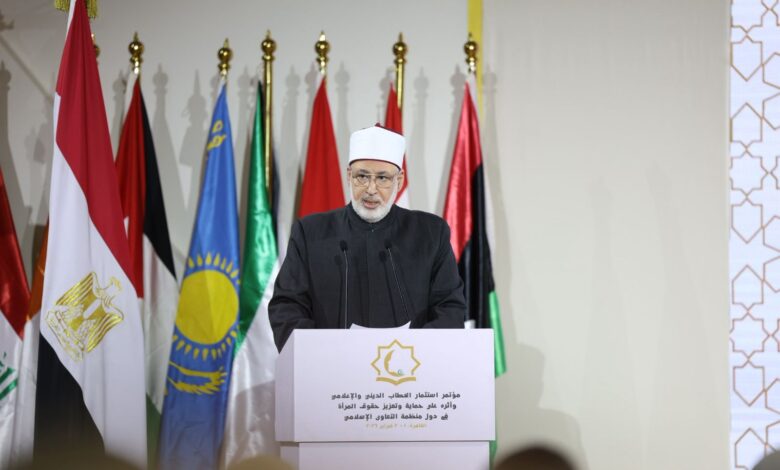
His Eminence Prof. Mohammad ad-Duwini, Deputy of al-Azhar and member of the Board of Directors of the World Organization for al-Azhar Graduates, said, at the conclusion of the conference “Harnessing Religious and Media Discourse and Its Impact on the Protection and Promotion of Women’s Rights in the Member States of the Organization of Islamic Cooperation”, that this distinguished two-day conference was held to discuss the role of religious and media discourse in protecting women and enhancing their status, and translating humanitarian and religious values in promoting their rights.
The Deputy of al-Azhar emphasized during his closing speech that the generous patronage of His Excellency President Abdel Fattah El-Sisi, President of the Arab Republic of Egypt, reflects the Egyptian state’s belief in the status of human beings and the necessity of empowering women as a genuine partner in sustainable development, a fundamental pillar in Egypt’s Vision 2030, and an influential actor in building society and the nation.
Prof. ad-Duwini added that al-Azhar ash-Sharif, under the leadership of His Eminence the Grand Imam of al-Azhar, addresses women’s issues and distinguishes between the fixed religious text and the inherited customs and traditions, emphasizing that the misunderstanding or applying religious discourse out of context leads to diminishing women’s rights or limiting their roles.
His Eminence explained that the challenges women face in some aspects of their lives are not due to religious texts, but rather due to the confusion in some discourse that addresses their issues, adding that al-Azhar, through its curricula and scholars, has always confronted misconceptions, extremist interpretations, and outdated traditions that attempted to diminish their rights.
His Eminence stated that al-Azhar carries a special concern for women, as its scholarly and jurisprudential discourse has witnessed their vindication, affirming their full right to obligation, responsibility, and community participation, and rejecting all forms of injustice and discrimination practiced in the name of religion or falsely attributed to it.
Prof. ad-Duwini continued that al-Azhar’s role has not been limited to theoretical discourse, but has extended to practical and institutional practices, through supporting women’s education at various levels, enabling them to engage in preaching and scholarly work, active participation in international conferences and forums related to their rights, in addition to awareness campaigns, books, and articles to correct misconceptions and protect women from erroneous practices and stagnant customs.
At the conclusion of his speech, the Deputy of al-Azhar revealed the most important recommendations of the conference, which came as follows:
First: The necessity of responsible handling by the media of women’s religious and social issues, to provide a voice of guidance and direction that contributes to limiting the chaos of aberrant fatwas and vulgar stereotyping of women, in coordination with official religious institutions.
Second: The necessity for researchers and scholars in women’s issues to adhere to sound scientific methodology and precise objectivity when dealing with women’s religious, heritage, and contemporary issues, with the necessity of distinguishing between what is a religious text and what is an intellectual and knowledge heritage that was subject to different temporal and spatial contexts in which customs and traditions were observed in a manner that cannot be adopted or adhered to in contemporary reality.
Third: The necessity of intensifying national and institutional efforts and programs toward strengthening social cohesion, reuniting the family, and achieving its stability. In this context, we value the great efforts exerted by al-Azhar ash-Sharif, represented by the al-Azhar Fatwa Global Center and the Islamic Research Academy, in reuniting the Egyptian family and holding awareness programs that protect the family from social disintegration.
Fourth: The necessity of establishing controls and standards to limit the dangers of technological development on the family in general and women in particular, as this development, including artificial intelligence, has become a dangerous tool through which women can be threatened, their dignity violated, and they can be blackmailed in ways that weaken their family and social stability.
Fifth: Emphasizing the directive not to exaggerate dowries and to facilitate marriage matters whenever its considered conditions are met, in order to contribute to limiting the phenomena of spinsterhood and early divorce in society. In this context, we value and encourage all social initiatives that seek to facilitate marriage matters and reject exaggeration in dowries.
Sixth: Adopting a comprehensive institutional approach to combating violence against women, integrating religious, media, educational, and social tools and including women’s and family issues among the priorities of societal stability.
Seventh: Disseminating the fatwas of the Council of al-Azhar Senior Scholars supporting women’s rights through religious and media discourse, as a contemporary reference that corrects misconceptions, criminalizes domestic violence, and supports women’s right to work, inheritance, choosing a spouse, holding positions, safe travel, and regulates the concepts of guardianship, divorce, and dowry, in a way that preserves the family entity and its stability.
Eighth: Establishing permanent mechanisms within Fatwa institutions to detect suspicions related to women and the family, and provide rapid scholarly responses to them through accredited digital platforms, and benefit from al-Azhar’s pioneering experiences and expertise in this regard.
Ninth: Employing drama and cultural production as tools for building societal awareness, through supporting works that promote family and societal cohesion and preserve family values and their sanctity.
Tenth: The necessity of integration between religious and media discourse, as true awareness cannot be achieved except through enlightened religious discourse and responsible media that come together to clarify terminology and correct concepts.
This conference was held under the patronage of His Excellency President Abdel Fattah El-Sisi, President of the Arab Republic of Egypt, and in the presence of His Excellency Dr. Mostafa Madbouly, Egypt’s Prime Minister, and His Eminence Prof. Ahmad at-Tayyeb, the Grand Imam of al-Azhar. The conference was organized by al-Azhar ash-Sharif, the National Council for Women, and Women Development Organization of the Organization of Islamic Cooperation, from February 1-2, 2026, at al-Azhar Conference Center, with the attendance of high-level representatives from the 57 member states of the Organization of Islamic Cooperation. The conference aimed to highlight the role of sound religious and media discourse in correcting misconceptions and promoting a culture of respect for women’s rights.