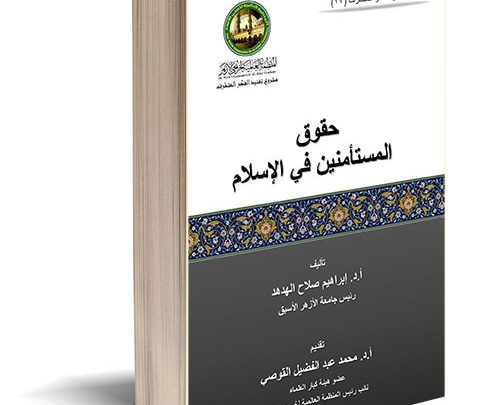
By:
Prof. Ibrahim al-Hudhud
Former President of al-Azhar University
Introduction
Praise to Allah, the lord of all beings, who created the human beings all from one soul, as mentioned in the Holy Qur’an: “O people, fear your Lord, Who created you of a single soul, and from it created its mate, and from the pair of them scattered many men and women” [Q.4:1]. Indeed, Allah Almighty addressed humanity several times in the Holy Qur’an with the phrase “O People”, as He says: “O people! We have indeed created you from a male and a female, and made you nations and tribes that you may come to know one another” [Q.49:13]
In fact, the human diversity establishes mutual cooperation and communication not fighting and estrangement, as Allah Almighty has created this universe to contain and embrace all kinds of differences, as He says: ” Had Allah willed, He would have made mankind one community, but they continue to differ” [Q.11:118]; thus, the whole universe fits to contain all kinds of diversity. Islam, its rulings and judgments as well have the capability to establish peaceful coexistence between all humans without exclusion or oppression or compulsion in religion, and within the framework of rights and duties.
As a matter of fact, Prophet Muhammad (PBUH) came to Medina, and its population at that time was about ten thousands, divided as follows: 1500 of Muslims, 4500 of Jews and the rest were of non-Muslims and people of the book; that is why, the Constitution of Medina had laid down the foundations of peaceful coexistence among the followers of the different religions, even those following no heavenly religion. Indeed, Prophet Muhammad (PBUH) did not exclude anyone, except the Jews who committed treason, and helped the enemies against their homelands.
Hence, it is apparent to us that Islamic Shari’ah has guaranteed all the citizens, immigrants and visitors of non-Muslims infallible rights. In fact, this stance suits the universality of Islam, as we will explain in the following pages the meaning of “Musta’man” and his/her rights in Islam, as well as the opposing point of view to the authentic agreed point of view of senior Muslim scholars.
Definition of ‘Aman (Safety)
In the Arabic language, the phrase “to provide safety” means to guarantee protection; hence, we have here a mutual relation between “Mo’amin” (the one who provides safety and protection) and “Musta’man” (the one who enjoys safety and protection).
Mo’amin: those in responsibility (e.g. Ruler, Guardian) who provide and guarantee safety and protection, represented nowadays in the authorities providing visa and residence permission.
Musta’man (Protégé): the non-Muslim seeking safety and protection to enter the Muslim country for a given period of time.
The form of guaranteeing safety: there is neither specific form to provide and guarantee safety and protection, nor it is restricted to a certain term, and it might differ from time to time. Thus, visa and residence permission are considered as a safety and protection covenant.
The Misinterpretation of the Term “Dhimmi“
The ancient jurists coined the term “Dhimmi” to refer to non-Muslims living in the Muslim state. In fact, that term is a fair one, and not as misunderstood by some people. The Dhimmis are non-Muslims whom Prophet Muhammad (PBUH) guaranteed them protection and safety; they became under the protection and safeguard of the Prophet and the rest of Muslims forever.
According to Sahih Muslim, the Prophet (PBUH) said in one of the Hadiths: ” When you lay siege to a fort and the besieged appeal to you for protection in the name of Allah and His Prophet, do not accord to them the guarantee of Allah and His Prophet, but accord to them your own guarantee and the guarantee of your companions for it is a lesser sin that the security given by you or your companions be disregarded than that the security granted in the name of Allah and His Prophet be violated”.
As such, the Rashidun Caliphs and Muslim rulers throughout history followed the abovementioned commands, and guaranteed non-Muslims protection and safeguard. Unfortunately, the terrorist and extremist group ignored such commands of Allah and His Prophet (PBUH) and falsely assaulted the Dhimmis.
General Rights of Non-Muslims in the Islamic Countries
The general rights approved by the Islamic Law for non-Muslims in the Islamic countries, whether they are citizens or residents, are as follows:
1- Right to preserve human dignity: The Holy Quran made it crystal clear, as in this verse: “We have honored the Children of Adam and carried them on land and sea, and provided them with good things, and preferred them greatly over many of those We created.” [Q. 17:70]. The term is general and includes all human beings, regardless of their creed or races and it is not permissible for any person to insult anyone honored by Allah.
How to preserve their dignity? Considering their feelings and disputing them in the kindliest manner: “Dispute not with the People of the Book save in the fairer manner” [Q. 29:46]. Their beliefs shouldn’t be slighted. Moreover, Islam established this right enough to prohibit insulting their idols; “Abuse, not those to whom they pray, apart from God, or they will abuse God in revenge without knowledge.” [Q. 6:108]
Muslims respected the dignity of non-Muslims; when Mohammad ibn al-Ass hit the Christian man in the face saying, “I am the son of nobles”, he went to complain to Omar ibn al-Khattab. Then, Omar ibn al-Khattab summoned Amr ibn al-Aas and his son and gave the Christian a whip and said, “lash the one who lashed you”.
2- Right to freedom of belief: Islam does not compel anyone to convert to it; history did not record that anyone was compelled to enter Islam. Allah said: “And if thy Lord had willed, whoever is in the earth would have believed, all of them, all together. Wouldst thou then constrain the people, until they are believers?” [Q. 10:99]
Allah said also, “No compulsion is there in religion. Rectitude has become clear from error.” [Q. 2:256]
Allah said also, “Say: ’The truth is from your Lord; so let whosoever will believe, and let whosoever will disbelieve.” [Q. 18:29]
3- Right to practice their religion and invoke their law: This right is related to their personal status and social life. The jurists have decided that hudud punishments shouldn’t be carried out on them, except for what they think is forbidden, not for what they think is permissible, such as alcohol drinking and pork eating.
4- Right to justice: Islam is based on justice. Allah said in the Holy Quran: “O believers, be you securers of justice, witnesses for God. Let not detestation for a people move you not to be equitable; be equitable — that is nearer to godfearing. And fear God; surely God is aware of the things you do.” [Q. 5:8]
This means that hatred shouldn’t push us to oppress people. Besides, in the Hadith, “Beware, if anyone wrongs a contracting man, or diminishes his right, or forces him to work beyond his capacity, or takes from him anything without his consent, I shall plead for him on the Day of Judgment.” It is worth mentioning that the occurrences of justice in the shadow of the Islamic State were incalculable.
5- Right to protect their lives, money, and honor: Islam preserves the basic rights, such as protecting lives, money, and honor. It is noteworthy that these rights are equally guaranteed by Islam to all human beings; there is no difference between a Muslim and a non-Muslim, nor a citizen and an expatriate. There is much evidence in the Shariah of preserving such right, including what was said by the Prophet (PBUH) in this Hadith: “Whoever kills a Muahid will not smell the fragrance of Paradise, even though its fragrance could be smelt at a distance of forty years.” It is not valid to harm non-Muslims unjustly, seize their money or attack them; Prophet Muhammad (PBUH) said: “Whoever harms them, he has harmed me, and whoever harms me, he has offended Allah.”
It is narrated that The Messenger of Allah (PBUH) killed a Muslim who killed a Muahid who had made a covenant with the Muslims, and said, “I am closest to the ones who keep their covenants of protection.”
Needless to say that the rightly guided Caliphs followed the Prophet (PBUH) in this matter; In the days of Caliph Omar ibn al-Khattab (May Allah be pleased with him), a person of the tribe of Bakr bin wail kill a Dhimmi of Hirah. The Caliph ordered that the murderer be handed over to the kith and kin of the deceased. This was done and the successors of the deceased executed him.
In the days of Ali, (May Allah be pleased with him): A Muslim was accused of murdering a dhimmi, the charge having been proved, Ali ordered the execution of the Muslim. The brother of the deceased submitted, however, that he had forgiven him. But Ali was not satisfied and said that perhaps the people had threatened him. It was only when the brother of the deceased sought pardon for the murderer, persistently insisting, that he had received the blood money and that deceased will not return to life by the execution of his murderer, that „Ali gave his consent to release the murderer and said, “Whosoever, is our dhimmi, his blood is as sacred as our own and his property is as inviolable as our own property‟.
6- Their rights to being protected against aggression: Islamic countries must protect non-Muslims residing in their lands against any external aggression, defend them against attacks and fight on their behalf. This took place with Abu Ubaidah Ibn Al-Jarrah during the Conquest of the Levant and with other Muslim governors as well as leaders. Imam Al-Qarafi, in his book Al-Furuq (Differences), said “The contract of dhimmis gives them certain rights over us because they are in our land under our protection and under the protection of Almighty Allah, His Messenger (PBUH), and the Islamic religion. He who transgresses against them (dhimmis) – even with a mere word of injustice or backtalk – has jeopardized the covenant with Allah and His Prophet (PBUH) and the covenant of the religion of Islam”. (Al-Furuq, p.14)
Moreover, Amir Al-Mu’minin, Umar Ibn Al-Khattab (RA) used to enquire about the conditions of dhimmis whenever he met people coming from different provinces; they used to say “We don’t know except fair treatment and fulfilling pledges” (Tarikh Al-Tabari, 218/4)
7- Their rights to fair and humane treatment: This is the basic rule regarding treating non-Muslims as stated in the Holy Quran “Allah forbids you not, as regards those who have not fought you in religion’s cause, nor expelled you from your habitations, that you should be kindly to them, and act justly towards them; surely Allah loves the just. Allah only forbids you as to those who have fought you in religion’s cause, and expelled you from your habitations, and have supported in your expulsion that you should take them for friends. And whosoever takes them for friends, those — they are the evildoers.” [Q. 60: 8 and 9]
Imam Al-Qarafi explained “dealing kindly” by saying “gentleness towards the weak, providing clothing to cover them, and soft speech. This must be done with affection and mercy, not by intimidation or degradation.” (Al-Furuq, p.14)
In fact, the Prophetic Sunnah as well as books of Al-Sira Al-Nabawiyya (Prophetic Biography) are full of practical applications of the above-mentioned holy verse starting from Prophet Muhammad (PBUH), As-Sahabah (Companions of the Prophet), Muslim rulers and up to our present time.
Matters that witnessed ghulu (exaggeration) with regards to Musta’mins from the point of view of followers of Al-Wala’ wal-Bara’
- Muslims must disassociate from them: They prove this viewpoint using a number of Quranic verses. This idea has been refuted in the book entitled “Al-Wala’ wal-Bara’: Emergence and Concept” which is a part of this series.
- Muslims must not become friends with them or eat with them: This idea is refuted with the Holy verse “Today the good things are permitted you, and the food of those who were given the Book is permitted to you, and permitted to them is your food; Likewise believing women in wedlock, and in wedlock women of them who were given the Book before you if you give them their wages, in wedlock and not in license, or as taking lovers. Whoso disbelieves in the faith, his work has failed, and in the world to come he shall be among the losers” [Q. 5:5]
- Muslims must not imitate them in their lifestyles: Ibn Taymiyyah in his book, Iqtida al-Sirat al-Mustaqim (The Necessity of the Straight Path), mentioned that imitating them in outward matters necessitates imitating them in inward matters. This is regarded as ghulu since we wear clothes and watches made by them, our mobile phones are manufactured in their countries and we export various kinds of medicine from them. However, we do not imitate them with regards to their faiths and doctrines; the matter that is regarded as moderation.
Hence, the above-mentioned rights of Musta’mans, that go with the Holy Quran, Prophetic Sunnah, As-Sahabah and their followers, is regarded as the right path.