
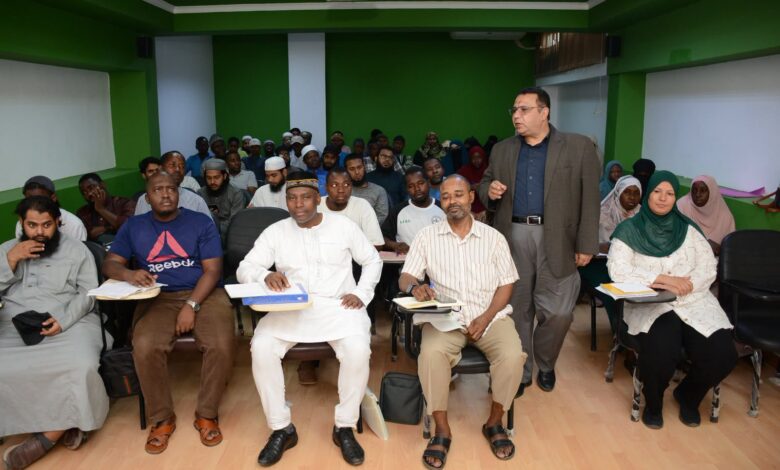
The World Organization for al-Azhar Graduates convened a workshop themed: “Contemporary Atheism: A Journey from Doubt to Certainty.” The workshop was lectured by Dr. Mohammad Abdul Rahim al-Bayoumi, Professor at al-Azhar University, with the participation of 50 international students from: Nigeria, Yemen, Afghanistan, Bangladesh, Cameroon, Burkina Faso, Togo, the Philippines, Algeria, Mali and Guinea. The workshop was held as part of a series of academic workshops organized by the Organization to support the moderation of Islam, reinforce al-Azhar thought in the minds of international students, and prepare them to serve as ambassadors of the moderate approach in their home countries. This came within the framework of the efforts exerted by the Organization to establish al-Azhar moderate approach among international students and enhance their awareness of intellectual and doctrinal issues.
Dr. al-Bayoumi affirmed that atheism represents one form of intellectual extremism opposed to religion, explaining that religious extremism and atheism, despite differing in their starting points, converge in that both transgress the moderate approach and rigor in reasoning. As such, this will, negatively, affects the relationship between human beings, religion and values. While religious extremism contributes to distorting the image of Islam, atheism leads to a severance from religion and values.
He explained that human beings, by their nature, seek certainty, and that dialogue based on rational proof represents an important means of reinforcing certainty in the believer and responding to intellectual doubts. He stressed as well the importance of calling others to guidance through wisdom and fair exhortation. In this context, he distinguished between atheism and other intellectual orientations, explaining that deism affirms the existence of a Creator of the universe but denies revelation and prophetic messages, whereas atheism is based on denying the existence of the Creator altogether, while agnosticism holds that the human mind cannot definitively affirm or deny the existence of Allah.
Dr. al-Bayoumi noted that the human soul, by its nature, goes through life experiences and situations that prompt reflection on the reality of existence. He affirmed that common sense and rational mind both reject the notion of absurdity, yet call for reflection on the precision and order of the universe’s system, which leads to the recognition of the existence of a wise Creator of this universe.
He concluded the workshop by emphasizing the importance of intellectual dialogue grounded in reason and proof in addressing issues of atheism and intellectual doubts. He noted that the COVID-19 pandemic revealed the limits of human capability and demonstrated humanity’s weakness before minute creatures invisible to the naked eye, which calls for reflection on the power of Allah Almighty and His laws (Sunan) governing the universe, and for a reconsideration of materialist conceptions that disregard the dimensions of faith and the purpose of existence.